
A leaning, cracked or bulging retaining wall in Colorado Springs is almost always a water problem first and a block problem second. Water trapped behind the wall, clay soil that swells when it gets wet, and freeze-thaw cycles push on the wall until it moves. Small cracks and a few loose caps are a routine retaining wall repair in Colorado Springs. A wall that leans badly, bulges in the middle or sits on a failed footing usually has to come down and be rebuilt with proper drainage.
Retaining walls rarely fail overnight here. They creep a little each winter until a block pops out or the top row tilts toward the lawn. Below: what each warning sign means, when retaining wall repair in Colorado Springs will hold, when a rebuild is the better spend, and how the local permit rules work.
Why Retaining Walls Fail in Colorado Springs
A retaining wall holds back soil that wants to slide downhill. Most walls that fail were built strong enough for dry soil. The trouble starts when that soil gets wet.
Water pressure behind the wall
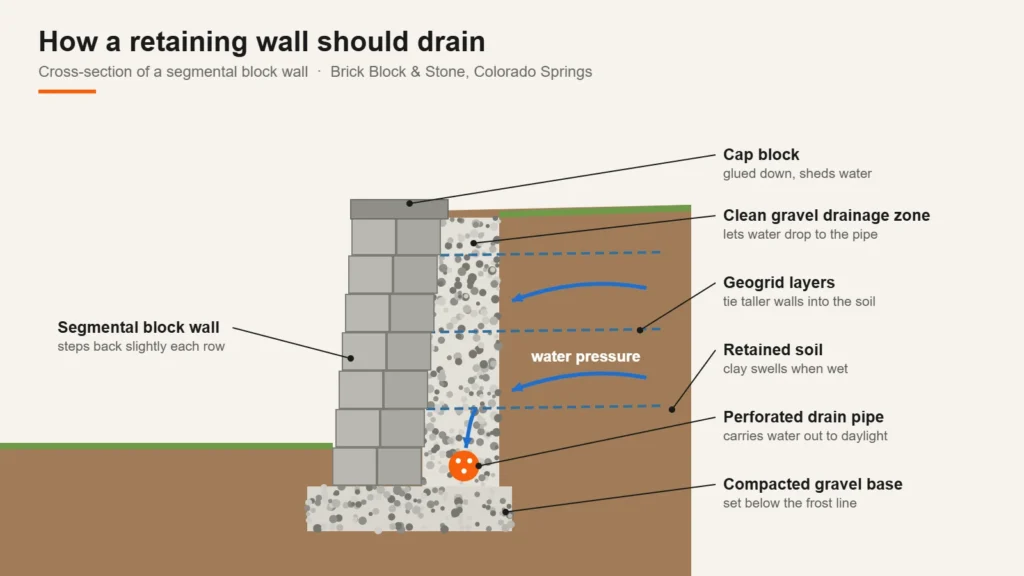
Saturated soil is much heavier than dry soil, and the water in it pushes sideways against the wall. Without a gravel drainage zone and a perforated drain pipe at the base, that pressure has nowhere to go. Snowmelt, a downspout aimed at the slope, or a sprinkler zone on the high side can keep the soil behind the wall wet for weeks.
Clay soil that swells
The Colorado Geological Survey calls expansive soil Colorado’s most significant geologic hazard. Parts of Colorado Springs sit on clay soils and clay bedrock that swell when they take on water and shrink as they dry. Season after season, that cycle pushes a retaining wall outward like a slow jack.
Freeze-thaw
Our winters swing above and below freezing many times. Water in the soil and in mortar joints freezes, expands and pries things apart. Over a few winters this loosens caps, cracks mortar and lets the base settle unevenly.
Shortcuts during construction
Many failing walls were built without enough base depth, without compacted gravel, without geogrid on taller block walls, or with native clay used as backfill. They can look fine for years before water and frost catch up with them.
Warning Signs: Leaning, Cracked or Bulging
Each symptom points to a different problem behind the wall.
A leaning retaining wall
If the whole wall tips forward at the top, the base or footing is rotating. The soil is pushing harder than the wall was built to resist, usually because of water or because the wall is too tall for its design. A slight lean on a short garden wall can sometimes be stabilized. A lean that is getting worse, or that you can see from across the yard, usually means rebuilding from the base.
A bulging retaining wall
A bulge in the middle of the wall means pressure is concentrated in one area. That often points to failed drainage in that section, a blocked drain pipe, or a low spot where water collects. Bulging block walls rarely settle back, and the bulge tends to grow.
Cracks in the wall
Not every crack is an emergency.
- Hairline cracks in mortar or poured concrete that are not growing are often cosmetic and can be sealed or repointed.
- Stair-step cracks along the mortar joints of a block or brick wall usually mean part of the footing is settling.
- Horizontal cracks, or cracks wider at the top than the bottom, come from soil pressure and need a closer look soon.
- A crack with one side pushed out farther than the other means the wall is moving.
Other signs to watch
- Blocks or stones that have shifted, rotated or popped out
- Caps that are loose or sliding off
- Soil washing out under the base or through the joints
- Puddles or soggy ground at the top of the wall after rain
- White, chalky stains (efflorescence), which show water is moving through the wall
A simple check: hold a 4-foot level against the face of the wall and take a photo. Do it again a month later. If the gap has changed, the wall is still moving.
Retaining Wall Repair Options
The right fix depends on what failed, so the cause comes first. Patching the face of a wall without dealing with the water behind it usually buys a season or two.
Repairs that work for minor damage
- Repointing and crack repair: grinding out failed mortar and replacing it, or sealing stable cracks in concrete.
- Replacing cracked or spalled block and stone, and resetting loose caps with proper adhesive.
- Fixing drainage: clearing or adding weep holes, moving downspouts and sprinklers away from the top of the wall, and regrading so water runs off instead of soaking in.
- On segmental block walls, taking down a small leaning section and relaying it on a new compacted base, without rebuilding the whole wall.
When a rebuild is the better choice
Rebuilding usually makes more sense when:
- the wall leans noticeably or the lean is getting worse,
- the bulge covers a large part of the wall,
- the footing has cracked or settled,
- the wall has no drainage and the soil behind it stays wet, or
- it is an old timber wall that is rotting.
A proper rebuild means excavating behind the wall, building a compacted gravel base below the frost line, installing a perforated drain pipe with clean gravel backfill, adding geogrid where the height calls for it, and then relaying the block or stone. It costs more up front, and it removes the cause instead of covering it.
Do You Need a Permit to Repair a Retaining Wall in Colorado Springs?
Colorado Springs and unincorporated El Paso County fall under the Pikes Peak Regional Building Department (PPRBD). Under the regional code, a retaining wall 4 feet or less, measured from the bottom of the footing to the top of the wall, that does not support a surcharge is exempt from a building permit. A surcharge is extra load on the soil behind the wall, such as a driveway, a parking area, a building or a slope above it.
Walls over 4 feet, or any wall holding up a surcharge like a driveway, need a permit with engineered plans; El Paso County planning also lists setback approval for walls 4 feet and taller. If your repair turns into a rebuild of a taller wall, plan for engineering and a permit. Many HOAs add their own approval step, so check your covenants before work starts. Rules change, so confirm with PPRBD at 719-327-2880 or with your contractor before anyone digs.
Free estimate
Have a project like this? Get a free estimate
Send us a few details and a local Brick Block & Stone pro will contact you. Prefer to talk? Call 719-723-1081.
What Affects the Cost of Retaining Wall Repair
Every wall is different, and a real number comes from seeing yours. These are the things that move the price:
- Repair or rebuild. Resetting caps or repointing costs far less than excavating and rebuilding.
- Height and length. Taller walls need more excavation, more base material and often engineering.
- Material. Segmental block, poured concrete, natural stone, boulders and timber all repair differently.
- Access. A wall at the back of a narrow lot with no room for equipment means more hand work.
- Drainage. Drain pipe, gravel backfill and regrading add cost, and they are usually what makes the repair last.
- Permits and engineering, required for walls over 4 feet or walls with a surcharge.
A written estimate should say what caused the damage, exactly what will be repaired or rebuilt, how drainage will be handled, and whether a permit is needed.
How We Handle Retaining Wall Repair
Brick Block & Stone has been building and repairing masonry in Colorado Springs for more than four decades. On every retaining wall repair we:
- Inspect the wall and the slope above it to find where the water and pressure are coming from.
- Tell you plainly whether a repair will hold or a rebuild is the better use of your money.
- Check PPRBD permit requirements when the wall’s height or load calls for it.
- Fix the drainage as part of the job, not as an add-on.
- Give you a free written estimate before any work starts.
See our retaining wall services, or for block walls, block repair and construction. If the footing itself has failed, footing services covers how we rebuild from the base.
Frequently Asked Questions
Can a leaning retaining wall be straightened?
Sometimes. A short segmental block wall with a small lean can often be taken down and relaid on a new base. Poured concrete and mortared walls usually can’t be pushed back into place. If the lean is growing or the footing has rotated, rebuilding with proper drainage is the fix that lasts.
How do I know if my retaining wall is about to fail?
Watch for a lean that is getting worse, a growing bulge, new cracks that widen, blocks popping out, or soil washing out at the base. If any of these change over a few weeks, or the wall holds up a driveway or sits near a building, keep people away from it and get it inspected soon.
Is a cracked retaining wall dangerous?
Hairline cracks that aren’t growing are usually cosmetic. Horizontal cracks, cracks wider at the top, or cracks where one side has pushed out mean the wall is moving under soil pressure. Have those inspected before the next wet season, especially on walls taller than 3 or 4 feet.
Why does my retaining wall have white stains?
White, chalky deposits are efflorescence: minerals left behind as water moves through the wall and dries. The stain itself does no harm. The water does, and it usually means drainage behind the wall is missing or blocked.
Should I repair my retaining wall in winter or wait for spring?
Inspections and planning can happen any time, and winter is a good time to line up estimates and permits. Excavation, base and mortar work goes best when the ground isn’t frozen. If a wall is actively failing near a driveway, walkway or house, don’t wait for spring; get it inspected now.
Get Your Retaining Wall Looked At
Caught early, a leaning or cracked wall is usually an affordable repair; left to move for another winter, it often becomes a rebuild. For retaining wall repair in Colorado Springs, contact Brick Block & Stone or call 719-723-1081 for a free written estimate.
