In this article 10 sections
- 1Why Commercial Retaining Walls Are Different
- 2Common Problems on Colorado Springs Commercial Properties
- 3What Property Managers Should Check
- 4Repair or Rebuild Commercial Retaining Walls?
- 5Permits and Engineering in Colorado Springs
- 6What Affects the Cost of Commercial Retaining Walls
- 7Planning Work Around Tenants and Traffic
- 8How Brick Block & Stone Helps Property Managers
- 9Frequently Asked Questions
- 10Get Your Property’s Retaining Walls Assessed
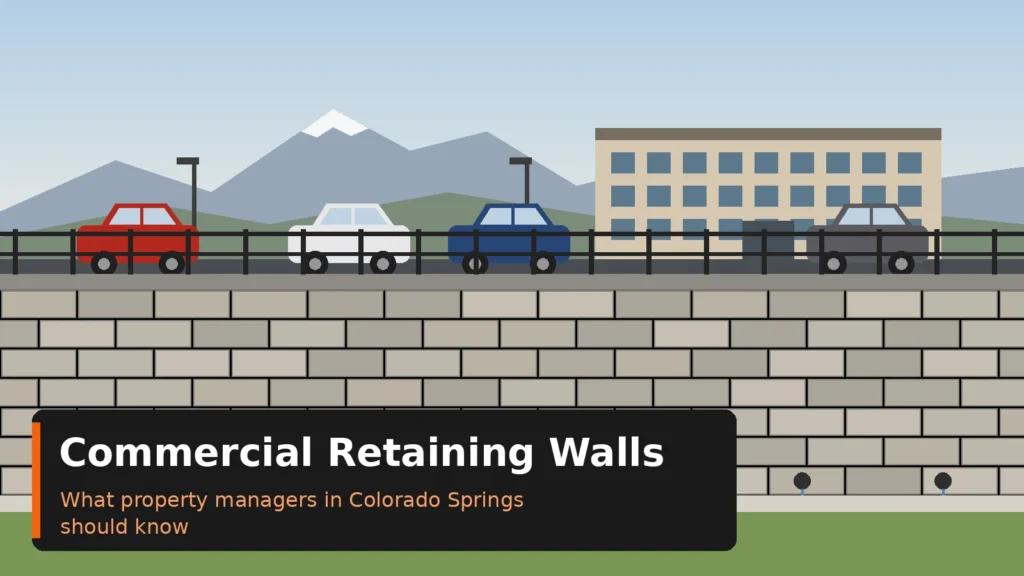
Quick answerCommercial retaining walls in Colorado Springs carry more than soil. They hold up parking lots, drive lanes, loading areas and snow piles, and they take runoff from acres of pavement. That extra load and water is why commercial walls need engineered design, regular inspections and fast repairs. A small crack ignored for two winters can turn into a closed parking row.
If you manage an office park, retail center, apartment community or HOA common area, the walls on your property are easy to forget until something moves. This guide covers what makes commercial retaining walls different, the most common problems on Colorado Springs properties, what to check twice a year, when repair is enough, and how permits and engineering work here.
Why Commercial Retaining Walls Are Different
A backyard garden wall holds back a few feet of soil and not much else. A commercial wall often has cars, trucks, dumpsters or a building sitting near the top. Engineers call that extra weight a surcharge, and it changes how the wall has to be designed and built.
Heavier loads at the top
Parking spaces, fire lanes and delivery routes push down on the soil behind the wall, and that soil pushes sideways on the wall. Snowplows add another load in winter when they stack plowed snow along the top edge. A wall that was fine for landscaping can start to lean once a parking row is added above it.
More water from paved areas
Asphalt and concrete do not soak up rain or snowmelt. Water runs across the lot, collects at low spots and often ends up behind the wall. If the drainage behind the wall is undersized or clogged, that water builds pressure fast. In Colorado Springs, where clay soils swell when wet and freeze-thaw cycles repeat all winter, that water does even more damage.
Higher stakes and liability
When a commercial wall fails, it can damage vehicles, block access, cut off parking for tenants and create a fall hazard for pedestrians. Insurance carriers, owners and tenants will all want to know what was inspected and when. That is why commercial walls deserve a written inspection routine, not just a glance when someone notices a problem.
Common Problems on Colorado Springs Commercial Properties
Most failures on commercial sites come from a short list of causes. Many of them start with routine site maintenance rather than the wall itself.
- Snow piled against the top or face of the wall by plow crews, which adds weight and soaks the soil when it melts.
- Plow blades and vehicles chipping caps and knocking out face units.
- De-icing salt running down the wall face and breaking down mortar and concrete over time.
- Clogged weep holes and drain outlets, so water has nowhere to go.
- Downspouts, curb cuts or parking lot drains that dump water right behind the wall.
- Irrigation along the top of the wall that keeps the soil wet all season.
- Tree roots growing into joints and lifting caps.
- Settling where utility trenches were cut near the base and backfilled poorly.
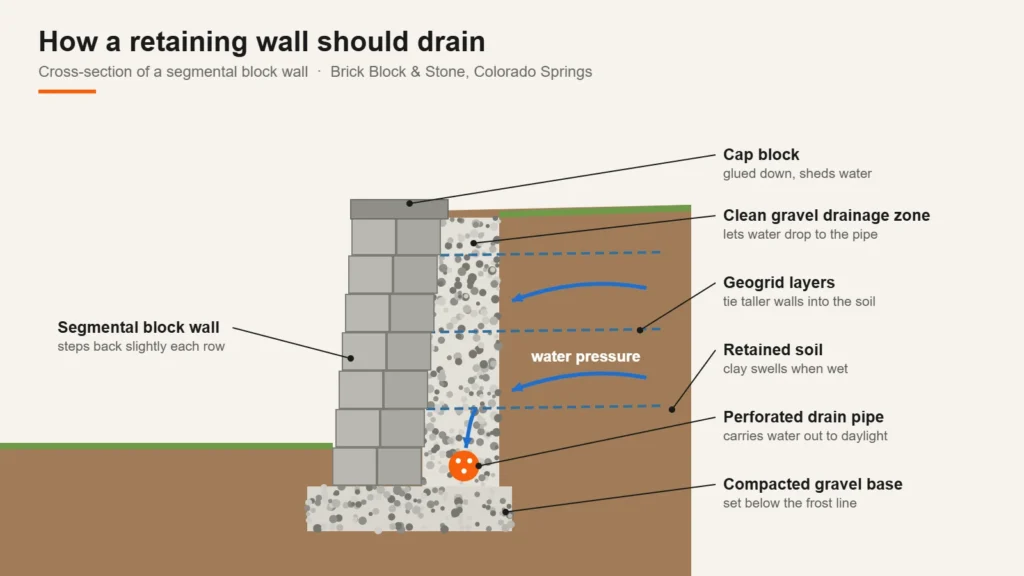
Water is behind most of these problems. A wall built with a clean gravel drainage zone, a perforated pipe at the base and a clear outlet can handle a lot. The same wall with a crushed pipe or a buried outlet starts to bulge within a few seasons.
What Property Managers Should Check
You do not need to be an engineer to spot early warning signs. A simple walk-through, done the same way each time, catches most problems while they are still small.
Walk the walls twice a year
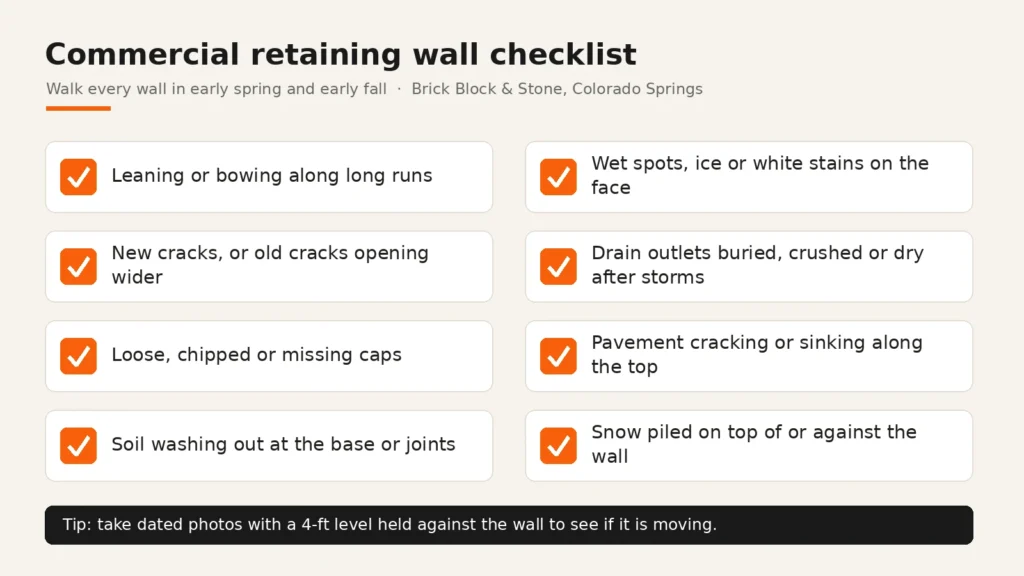
The best times are early spring, after the snow has melted, and early fall, before plowing starts. Walk the full length of each wall from the bottom and the top. Look for:
- Leaning or bowing, especially near the middle of long runs.
- New cracks, or old cracks that have opened wider.
- Loose, chipped or missing caps and face units.
- Soil washing out at the base or through joints.
- Wet spots, ice buildup or white chalky stains on the wall face.
- Drain outlets that are buried, crushed or dry after a storm.
- Pavement at the top that is cracking or sinking parallel to the wall.
Check again after big storms
Heavy spring snow and summer thunderstorms are when walls are under the most pressure. After a big event, look at the outlets: water should be coming out. If the outlets are dry while the ground behind the wall is soaked, the drainage is blocked.
Keep a simple record
Take photos from the same spots each time, with a 4-foot level held against the wall in a few places. Note the date and anything that changed. Over a year or two, those photos show whether a wall is stable or slowly moving, and they give your engineer and contractor real information to work with.
Repair or Rebuild Commercial Retaining Walls?
The answer depends on why the wall is moving, not just how it looks. A contractor should find the cause before quoting a fix.
Repairs usually make sense when the damage is limited to the face of the wall or the drainage can be restored. Typical commercial repairs include:
- Replacing damaged caps and face units, and resetting loose caps with proper adhesive.
- Repointing or patching cracked mortar and concrete.
- Clearing or replacing drain outlets and adding weep holes.
- Rerouting downspouts and parking lot drainage away from the wall.
- Relaying a short section of a segmental block wall on a new compacted base.
A rebuild is usually the better choice when a wall leans noticeably, bulges across a long section, sits on a cracked or settled footing, or was built without drainage. On a commercial wall that supports a parking lot, a rebuild also means engineered design, so the new wall is sized for the actual loads at the top, not just the soil.
Permits and Engineering in Colorado Springs
Colorado Springs and unincorporated El Paso County use the Pikes Peak Regional Building Department (PPRBD). Retaining walls over 4 feet tall, measured from the bottom of the footing to the top of the wall, and walls of any height that support a surcharge such as a driveway or parking area need a building permit with engineered plans.
On commercial sites, nearly every wall near a parking lot or drive lane falls into that second group. In practice, that means:
- A licensed engineer designs the wall, including the base, reinforcement such as geogrid, and drainage.
- The plan reviewer may ask for soil information, and many engineers will want a geotechnical report before they design.
- Where people can walk along the top and there is a drop of more than about 30 inches, building codes generally require a guard or fence.
- Inspections happen during construction, so the work has to be scheduled around them.
El Paso County planning also lists setback and approval requirements for walls 4 feet and taller. Requirements change and every site is different, so confirm with PPRBD and your engineer before work begins.
What Affects the Cost of Commercial Retaining Walls
Every commercial wall is different, and a useful number comes from seeing the site and the loads it carries. These are the factors that move the price most:
- Repair versus rebuild, and how much of the wall is affected.
- Height, length and whether the wall is tiered.
- Loads at the top, such as parking, fire lanes or truck traffic.
- Material: segmental block, poured concrete, masonry or natural stone.
- Drainage work, including new pipe, gravel backfill and outlets.
- Engineering, soil testing, permits and inspections.
- Access, traffic control and how much of the lot has to be closed.
- Season: work in frozen ground takes extra steps, and spring calendars fill up quickly.
A good written estimate explains what caused the damage, what will be repaired or rebuilt, how drainage will be handled, who provides engineering, and how the work will be phased around your tenants.
Planning Work Around Tenants and Traffic
Commercial wall projects go more smoothly when they are planned before anything fails. Winter is a good time to get inspections, engineering and permits in place, so construction can start when the ground thaws.
Talk with your contractor about phasing the work so part of the parking stays open, keeping fire lanes and accessible parking clear, and scheduling noisy work outside peak business hours. Give tenants notice early, with clear dates and alternate parking.
How Brick Block & Stone Helps Property Managers
Brick Block & Stone has been building and repairing masonry in Colorado Springs for more than four decades. When you call us about a commercial wall, we:
- Walk the wall and the area above it with you to find where the water and load are coming from.
- Tell you plainly whether a repair will hold or the wall needs an engineered rebuild.
- Check PPRBD permit requirements and coordinate with your engineer when the wall’s height or load calls for it.
- Plan the work around your tenants, parking and access.
- Give you a free written estimate before any work starts.
Learn more about our retaining wall services and block repair and construction. If a wall is moving because the base has failed, our footing services explain how we rebuild from the bottom up. For warning signs on smaller walls, see our guide to retaining wall repair in Colorado Springs.
Frequently Asked Questions
Do commercial retaining walls in Colorado Springs need a permit?
Most do. PPRBD requires a building permit with engineered plans for walls over 4 feet, measured from the bottom of the footing, and for walls of any height that support a surcharge like a parking lot or driveway. Confirm the details for your site with PPRBD and your engineer.
How often should a commercial retaining wall be inspected?
Walk every wall at least twice a year, in early spring after snowmelt and in early fall before plowing starts, and again after major storms. Keep dated photos with a level held against the wall so you can see whether anything is moving over time.
Who is responsible for a retaining wall on commercial or HOA property?
It depends on where the wall sits and what your governing documents, leases or plats say. Walls on common areas are usually the owner’s or association’s responsibility. Check your property records and talk with your attorney or management company when a wall sits near a property line.
Can snow storage damage a retaining wall?
Yes. Plowed snow piled on top of or against a wall adds weight, and when it melts it soaks the soil behind the wall. Plow blades also chip caps and face units. Mark snow storage areas away from walls and ask plow crews to keep piles off the top edge.
Can a commercial retaining wall be repaired in winter?
Inspections, engineering and permits can all move forward in winter, and that keeps spring construction on schedule. Excavation, base work and mortar repairs go best when the ground is not frozen. If a wall is actively moving near parking or a walkway, close the area and get it inspected right away.
Get Your Property’s Retaining Walls Assessed
The walls that hold up your parking lot are carrying more than they were in the original plans if snow piles, new drainage or extra traffic have been added since. A twice-a-year check and fast repairs keep small problems from becoming closed parking rows. For commercial retaining walls in Colorado Springs, contact Brick Block & Stone or call 719-723-1081 for a free written estimate.

Brick Block & Stone is a masonry contractor in Colorado Springs with more than 40 years of experience in brick, block, stone, pavers and retaining walls. Questions about your own project? Call 719-723-1081 or send us a message.
