In this article 9 sections
- 1What Spalling Brick Looks Like
- 2How Freeze-Thaw Damages Brick
- 3What Causes Spalling Brick Besides the Weather
- 4How Spalling Brick Repair Is Done
- 5When Spalling Is a Bigger Problem
- 6What Affects the Cost of Spalling Brick Repair
- 7How to Prevent Spalling Brick
- 8Frequently Asked Questions
- 9Get Spalling Brick Checked Before It Spreads
Quick answerSpalling brick repair starts with finding the water. Spalling is when the face of a brick flakes, peels or pops off. In Colorado Springs the usual cause is freeze-thaw: water soaks into the brick, freezes overnight, expands and breaks the face away. Fix the moisture source first, then replace damaged bricks and repoint with compatible mortar.
Most homeowners notice it in spring. Chips of red clay sit on the ground under a chimney, a few bricks by the front steps look sandblasted, or the face of a garden wall has peeled off in thin sheets. A few spalled bricks are not a crisis. A wall that keeps getting worse every winter is telling you something is feeding it water. This guide explains what is happening inside the brick, where to look for the cause, how a proper repair is done, and how to keep it from coming back.
What Spalling Brick Looks Like
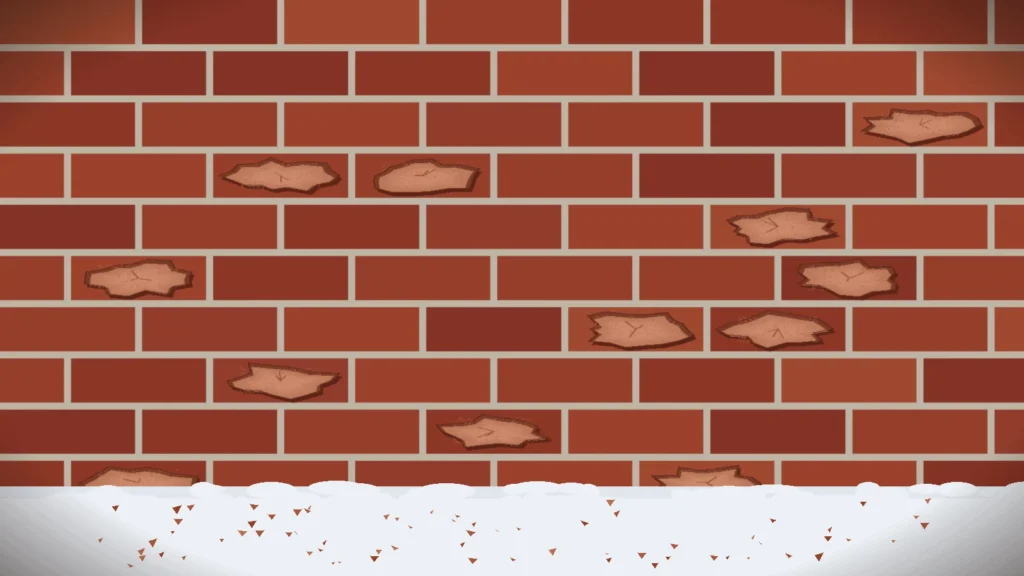
Spalling is different from ordinary weathering. Normal brick ages slowly and evenly. Spalled brick loses its outer face in pieces, and the damage is usually worse on some bricks than on the ones right next to them.
Look for these signs:
- Flaking or peeling faces. Thin layers of the brick face lift and fall away, leaving a rough, lighter-colored surface underneath.
- Pop-outs. Round or shell-shaped pieces break off the face, often the size of a coin or larger.
- Crumbling edges and corners. The edges of the brick turn soft and sandy and wear back from the mortar joint.
- Brick debris at the base of the wall. Red or tan chips on the ground, the porch or the top of a window sill.
- Damage in a pattern. Spalling grouped under a gutter, around a downspout, near the ground or on top of a chimney points straight at the water source.
- White deposits nearby. Efflorescence (white salt staining) on the same area means water is moving through the wall.
If you can push a screwdriver into the face of a brick and it feels like stale cake, the damage goes deeper than the surface. If the tip hits hard material right away, the brick may only have lost a thin layer.
How Freeze-Thaw Damages Brick
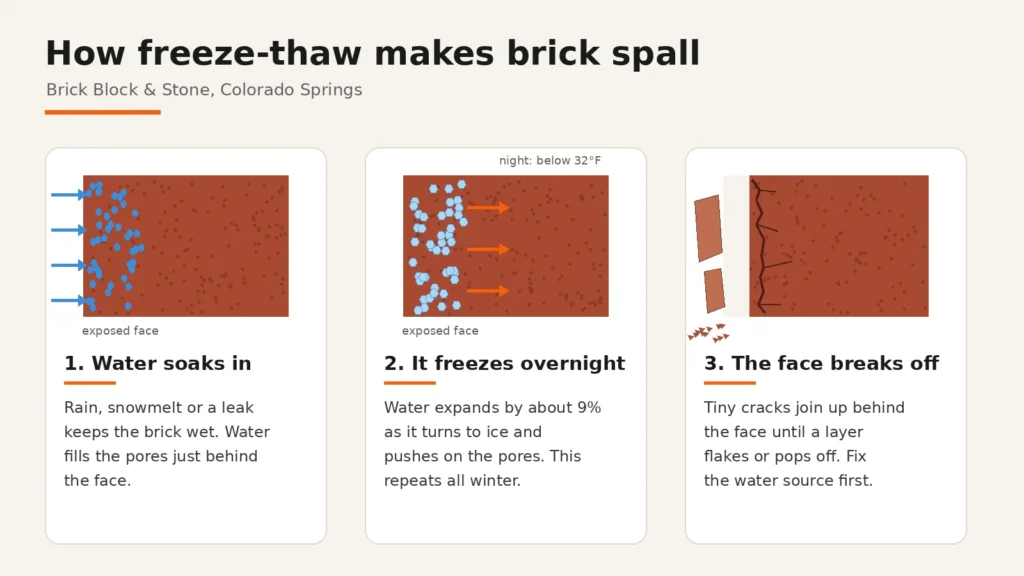
Brick is a fired clay product, and every brick has tiny pores. Those pores let the brick take on some water and then dry out again. Trouble starts when a brick stays wet and the temperature drops below freezing.
Water expands by roughly 9 percent when it turns to ice. Inside a saturated brick, that expansion pushes against the walls of the pores. One freeze does little. Dozens of freezes every winter, year after year, open small cracks just behind the face until the outer layer lets go. Salts carried in with the water add to the pressure as they crystallize under the surface.
Why Colorado Springs walls see so much of it
Our winters do not just get cold and stay cold. A typical Colorado Springs pattern is a sunny afternoon well above freezing followed by a hard freeze that night. Snow on the ground or on a ledge melts in the sun, soaks the brick, and freezes again after dark. That cycle can repeat many times in a single month from late fall into spring.
The sun makes it worse on south and west walls, which thaw more often. North walls stay wet longer. Either way, the brick that stays wettest is the brick that spalls first.
What Causes Spalling Brick Besides the Weather
Freeze-thaw is the force that breaks the brick, but something has to keep the brick wet enough for that to happen. When we look at spalling on a house in Colorado Springs, the cause is almost always one of these.
Water getting into the wall
- Gutters and downspouts. An overflowing gutter or a downspout that dumps against the wall soaks the same bricks every storm.
- Missing or failed flashing. Chimney tops, window sills, porch roofs and wall caps need flashing and drip edges that throw water clear of the brick.
- Cracked chimney crowns. A cracked concrete or mortar crown on top of a chimney lets water straight down into the brick below it.
- Open mortar joints. Eroded or cracked joints let water behind the face of the wall.
- Ground contact. Brick that sits in soil, mulch or snow piles wicks water up from below.
- Sprinklers. Heads that spray the wall keep the lower courses wet well into fall.
Mortar that is harder than the brick
Mortar is supposed to be the weaker, more breathable part of the wall. When a wall is repointed with a hard, cement-rich mortar, the joints stop moving and stop letting moisture out. Water dries out through the brick instead, and the brick takes the stress that the mortar should have taken. The National Park Service guidance on brick masonry problems warns that mortars high in portland cement can speed up deterioration of the surrounding brick, and that repair mortar should match the original in hardness and permeability. This is common on older homes and on walls that were repointed by someone in a hurry.
Sealers and coatings that trap moisture
A clear sealer or paint sounds like protection, but the wrong product traps water inside the brick. The water still gets in through cracks and joints, it just cannot dry out through the face. Then it freezes right behind the coating. The Brick Industry Association’s Technical Note 7A notes that properly built brick masonry does not need coatings, and that a water repellent used for the wrong problem can cause bigger ones.
Brick not suited to the exposure
Brick for severe freeze-thaw exposure, like ours, should be rated for it (Grade SW for building brick). Interior brick, soft reclaimed brick or brick that was never meant to be outside can spall fast once it is used on a cap, a step, a planter or a retaining wall.
Rough cleaning
Sandblasting and very aggressive pressure washing strip the hard fired skin off a brick. The softer core underneath absorbs more water and wears faster. Spalling that shows up a few winters after a cleaning job often traces back to that.
How Spalling Brick Repair Is Done
A lasting spalling brick repair follows the same order every time: stop the water, remove what has failed, rebuild with compatible materials, and let the wall dry.
- Inspect and find the source. We look at where the damage is and work backward to the water: gutters, flashing, crown, sprinklers, grading, joints. If the source is not fixed, new brick will spall too.
- Fix the moisture problem. Clear or reroute gutters and downspouts, repair or add flashing and drip edges, rebuild a cracked chimney crown, pull soil and mulch back from the wall, and adjust sprinkler heads.
- Cut out the damaged bricks. The mortar around each spalled brick is cut out with care, and the brick is broken out in pieces so the neighbors are not disturbed.
- Match the replacement brick. We match size, color and texture as closely as possible. On older homes, salvaged brick from a hidden area of the house is sometimes the best match.
- Lay the new brick with the right mortar. The mortar is chosen to be softer and more breathable than the brick, and matched in color and joint profile to the rest of the wall.
- Repoint failing joints nearby. If the joints around the repair are eroded, they are ground out to a consistent depth and repointed so water stops getting in.
- Leave the face breathable. We do not put film-forming sealers on brick. If a water repellent is ever considered, it has to be breathable and used only for the specific problem it is meant to solve.
Can you just patch a spalled brick?
Masonry patching compounds exist, and on a brick that has lost only a thin layer, a color-matched patch can work for a while. Patches on walls that stay wet tend to pop off within a few winters, and they rarely match the look of brick up close. On a chimney, a step or a wall cap, replacing the brick is usually the better spend. If only a few bricks have a light flake and the moisture source is fixed, some homeowners choose to leave them and watch them.
Can you flip the brick around?
Turning a spalled brick so the good back face shows is an old trick that sometimes works on solid brick. Many modern bricks have holes or a rough back, so this does not always work, and it does not fix the reason the brick spalled.
When Spalling Is a Bigger Problem
Most spalling is a surface problem that grows slowly. Call a mason soon if you see:
- Spalling on more than a handful of bricks in the same area, or spreading each spring.
- Spalling on a chimney, especially near the top, along with loose bricks or a cracked crown.
- Bulging, leaning or cracked brick along with the spalling.
- Brick that crumbles deep into the unit rather than just at the face.
- Spalled brick over a walkway, steps or a door where falling pieces could hurt someone.
A chimney is the most common place this turns serious. Our fireplace and chimney masonry work often starts with a crown or flashing repair that should have happened years earlier. Brick retaining walls and planters fail the same way, since they are wet from soil on one side. If a wall is also leaning, read our guide to retaining wall repair in Colorado Springs.
What Affects the Cost of Spalling Brick Repair
Every job is different, so we give a written estimate after we see the wall. These are the things that move the price:
- Number of bricks. A few bricks by the steps is a small job. A whole wall face is a different scope.
- Location and access. Ground-level work is simpler than chimney or second-story work that needs ladders, roof access or scaffolding.
- Brick matching. Common modern brick is easy to find. Older or discontinued brick can take time to match or salvage.
- The moisture fix. Flashing, a new chimney crown, gutter changes or regrading add to the job, but skipping them means paying again later.
- Repointing needed. If the joints around the damage are worn, repointing a larger area is part of doing it right.
- Season. Mortar needs to cure above freezing. Winter work may need heated enclosures or may be scheduled for milder days.
How to Prevent Spalling Brick
Prevention is mostly about keeping brick from staying wet:
- Keep gutters clean and extend downspouts at least a few feet away from the wall.
- Check chimney crowns, caps and flashing every fall before the snow starts.
- Keep soil, mulch, firewood and snow piles off the brick.
- Aim sprinklers away from brick walls and turn them off before the first hard freeze.
- Repoint eroded joints before water gets behind the face.
- Do not seal or paint brick to stop spalling unless a mason has found a specific reason to.
- Use exterior-rated brick for caps, steps, planters and walls, and do not use deicing salt right against brick steps and walls.
Our brickwork services cover repair and new work, and the same rules apply to both: the right brick, the right mortar and a clear path for water to leave the wall.
Frequently Asked Questions
Is spalling brick dangerous?
Usually not at first. Spalling is mostly a surface problem that gets worse slowly. It becomes a safety issue when pieces can fall from a chimney or a wall over a walkway, or when spalling comes with loose, bulging or cracked brick. In those cases, have the wall checked before the next winter.
What is the main cause of spalling brick?
Water that stays in the brick and then freezes. In Colorado Springs, daily freeze-thaw cycles do the damage, but the cause is whatever keeps the brick wet: gutters, failed flashing, a cracked chimney crown, open joints, sprinklers, soil against the wall, or a sealer or hard mortar that traps moisture.
Should I seal brick to stop spalling?
Not as a first step. Film-forming sealers and paint can trap moisture and make spalling worse. Fix the water source and the mortar first. A breathable water repellent is sometimes used for a specific problem, but it should be chosen by someone who has looked at the wall, not applied as a general fix.
Can spalling brick be repaired in winter?
Inspection and moisture fixes like gutters and downspouts can happen anytime. Mortar work needs temperatures above freezing while it cures, so brick replacement in winter is done on mild days or under heated protection. If pieces are falling over a walkway, close the area and have it checked right away.
Will new bricks match my old ones?
Often they can be matched closely. Common brick sizes and colors are still made, and a mason can match mortar color and joint style. Older or discontinued brick is harder, and salvaged brick from a hidden part of the house is sometimes the best option. New brick also weathers to blend in over time.
Get Spalling Brick Checked Before It Spreads
Spalling brick repair works when the water problem is fixed first and the wall is rebuilt with brick and mortar that suit our freeze-thaw winters. Brick Block & Stone has more than 40 years of masonry experience in Colorado Springs, and our written estimates are free. Call 719-723-1081 or contact us online and we will take a look at the wall and tell you what it needs.

Brick Block & Stone is a masonry contractor in Colorado Springs with more than 40 years of experience in brick, block, stone, pavers and retaining walls. Questions about your own project? Call 719-723-1081 or send us a message.
