In this article 11 sections
- 1Why Cracks in Block Walls Happen
- 2Stair-Step Cracks in Block Walls
- 3Horizontal Cracks in Block Walls
- 4Vertical Cracks and Hairline Cracks
- 5How to Check and Monitor a Crack Yourself
- 6Why Cracks in Block Walls Are Common in Colorado Springs
- 7How Block Wall Cracks Are Repaired
- 8What Affects the Cost of Repairing Cracks in a Block Wall
- 9When to Call a Mason About Cracks in a Block Wall
- 10Frequently Asked Questions
- 11Get Your Block Wall Checked
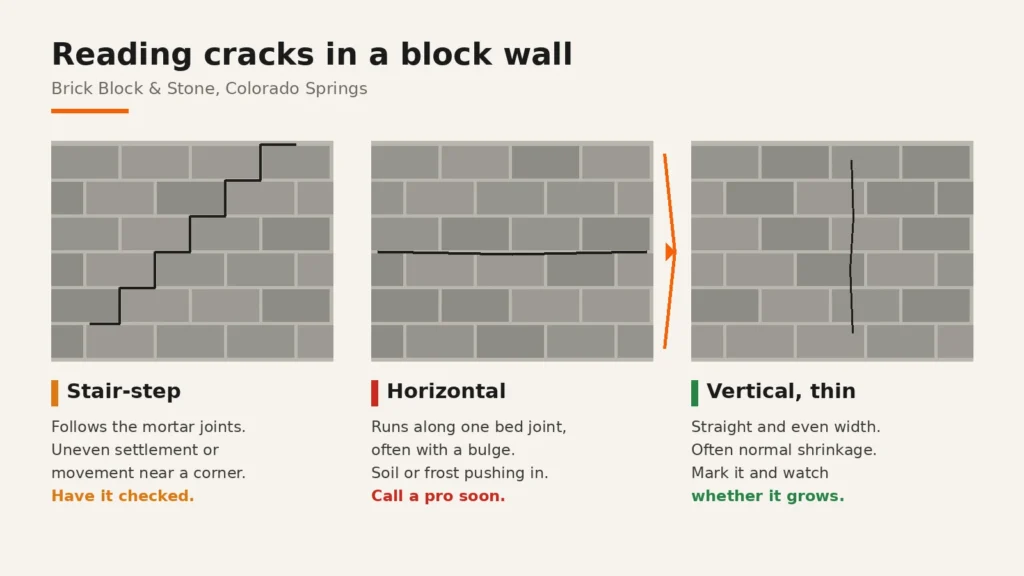
Quick answerCracks in block wall construction are not all equal. A thin vertical crack of even width is often just shrinkage and can be watched. Stair-step cracks that follow the mortar joints usually point to settlement, and horizontal cracks, especially with a bulge, mean soil or frost is pushing on the wall and need a professional look soon.
Concrete block is strong, but it is also stiff. When the ground under it moves, when soil presses on one side, or when the block itself shrinks as it dries, the wall has to give somewhere, and it gives at the weakest line: the mortar joints. The shape a crack takes tells you a lot about what is pushing or pulling on the wall. This guide walks through the three patterns we see most around Colorado Springs, how to judge which ones are urgent, and what a proper block wall repair looks like.
Why Cracks in Block Walls Happen
Almost every crack in a block wall comes from one of a handful of causes. Knowing them makes the crack patterns much easier to read.
- Shrinkage. Concrete block and mortar shrink slightly as they dry and as temperatures drop. If the wall is held tight at the footing and the top, that shrinkage turns into tension and the wall cracks, usually in a straight vertical line.
- Uneven settlement. When one part of the footing sinks more than the part next to it, the wall above tries to bend. Block cannot bend, so it splits along the joints in a stair-step pattern.
- Lateral soil pressure. Basement walls, crawlspace walls and retaining walls hold back soil. Wet, heavy or frozen soil pushes harder, and a wall without enough steel or drainage can crack horizontally and start to bow.
- Expansive clay. Clay soils swell when wet and shrink when dry, lifting and dropping footings and slabs with the seasons.
- Missing control joints. Long block walls need planned weak spots so shrinkage cracks form in a straight, sealed line instead of wherever they like.
The Concrete Masonry and Hardscapes Association technical note on crack control lists the same causes and explains why designers use control joints and horizontal reinforcement to keep shrinkage cracks small and in the right place.
Stair-Step Cracks in Block Walls
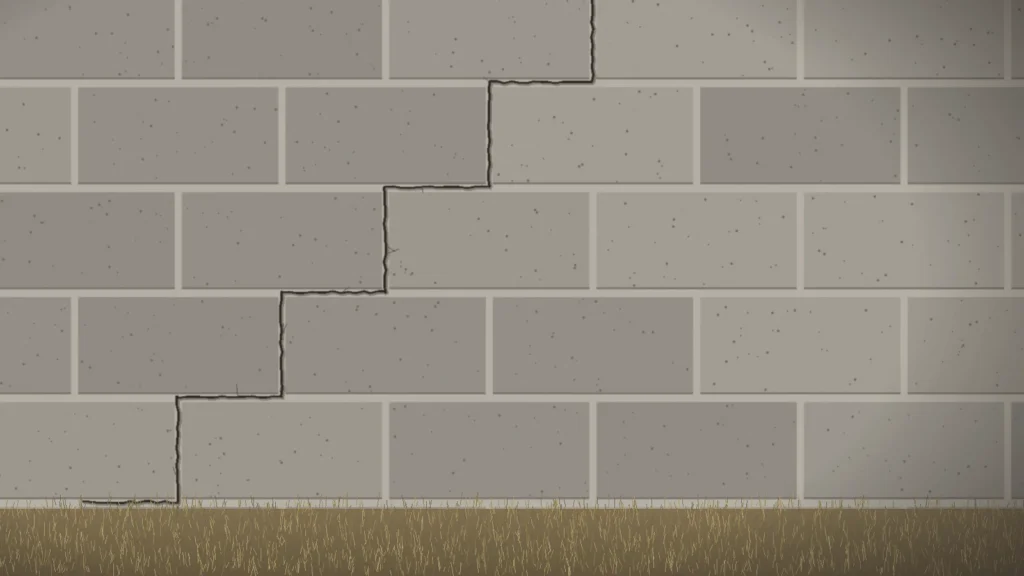
A stair-step crack zigzags up the wall: up a head joint, across a bed joint, up the next head joint, and so on. It almost always follows the mortar and leaves the blocks themselves intact.
What a stair-step crack usually means
This pattern is the classic sign of differential settlement. One end or corner of the wall has dropped a little more than the rest, and the wall is breaking along the easiest path. You often see stair-step cracks near the corners of a foundation or garden wall, under windows, or where a wall crosses from firm ground onto fill.
When a stair-step crack is a bigger problem
- The crack is wider at one end than the other, which means one side is still moving.
- Blocks on one side of the crack sit lower or stick out further than blocks on the other side.
- The same crack shows up again after it was patched.
- Doors or windows near the wall have started to stick, or the floor nearby slopes.
- The crack runs most of the height of the wall.
A short, hairline stair-step crack that has not changed in years may be old settlement that has stopped. A wide or growing one needs someone to find out why the footing moved before anything is patched.
Horizontal Cracks in Block Walls
A horizontal crack runs along one bed joint, often partway up a basement or retaining wall. Of the three patterns, this is the one to take most seriously.
What a horizontal crack usually means
Horizontal cracks form when soil on one side is pushing the wall sideways. The pressure bends the wall like a board, and it cracks where the bending is greatest, usually around a third to half of the way up. Saturated soil after a wet spring, frost pushing against a shallow wall, poor drainage behind a retaining wall, and heavy loads near the top (driveways, parked vehicles, stacked materials) all add to that pressure.
Signs that it needs attention soon
- The wall bulges or leans inward along the crack.
- The crack is wider than a credit card or is visibly opening.
- Blocks have slid sideways along the crack line.
- You see stair-step cracks at the ends of the horizontal crack.
- Water comes through the crack after rain or snowmelt.
A bowing wall can keep moving, and the fix gets bigger the longer it goes. If you see a horizontal crack with any bulge, keep heavy loads away from the top of the wall and get it inspected.
Vertical Cracks and Hairline Cracks
A straight vertical crack of even width, often near the middle of a long wall or below a window, is usually shrinkage. Block and mortar shrink as they cure and as the weather turns cold, and a wall without enough control joints relieves that stress with a crack.
Vertical cracks are the least worrying type, but they are still a way in for water. In our climate, water that gets into a crack freezes and widens it a little every winter. Watch for a vertical crack that is wider at the top than the bottom (or the reverse), since that points to settlement rather than shrinkage.
How to Check and Monitor a Crack Yourself
You do not need special tools to learn a lot about a crack. A few minutes now and again over a few months will tell you whether it is moving.
- Photograph it. Take a clear photo with a tape measure or coin beside the crack for scale.
- Mark the ends. Draw a short pencil line across each end of the crack and write the date next to it. If the crack grows past the line, it is active.
- Measure the width. Check the widest point. A rule of thumb many inspectors use is that hairline cracks are low concern, while cracks wider than about 1/8 inch, or ones that keep growing, deserve a professional opinion.
- Check for displacement. Run your hand across the crack. If one side sticks out past the other, the wall has shifted.
- Look for a bow. Hold a long level or a tight string along the wall. A gap in the middle means the wall is bulging.
- Note the weather. Cracks that open in winter and close in summer, or show up after a wet spell, tell you moisture and frost are part of the cause.
Why Cracks in Block Walls Are Common in Colorado Springs
Local conditions make block walls here work harder than in many places.
- Expansive clay. Much of the Front Range sits on clay that swells and shrinks with moisture. The Colorado Geological Survey notes that the forces from swelling soil can push upward, sideways or both, which is exactly what cracks a block wall.
- Freeze-thaw cycles. Sunny days followed by hard freezes mean water in open cracks freezes and thaws over and over through the winter. See our guide to winter masonry care in Colorado Springs for how to keep water out.
- Sloped lots. Many yards here need retaining walls, and a retaining wall without drainage carries extra water pressure every time it rains or snow melts.
- Fill soil. Walls built partly on loose fill settle more than walls on firm native ground.
How Block Wall Cracks Are Repaired
The right repair depends on the cause, which is why a crack should be diagnosed before it is filled. Patching a moving crack only hides it for a season.
Shrinkage and old, stable cracks
For hairline vertical cracks and settlement cracks that have stopped moving, the usual repair is to grind out the cracked mortar and repoint it, replace any cracked blocks, and seal the joint where water could get in. Where a long wall has no control joints, a mason may cut one in and seal it so future shrinkage happens in a neat line.
Settlement cracks that are still active
If the footing is still moving, the first job is to deal with what is moving it: usually water. That can mean fixing downspouts and grading so water drains away from the wall, then repairing the cracked section once movement stops. Serious footing settlement may need a structural engineer before any masonry repair.
Horizontal cracks and bowing walls
A wall that is cracked horizontally and bowing needs the soil pressure reduced and the wall strengthened. Depending on how far it has moved, that can mean improving drainage behind it, adding reinforcement, or rebuilding the damaged section with grouted cores and steel. Our article on steel reinforcement in block walls explains why rebar matters here. For retaining walls that lean or bulge, see our guide to retaining wall repair in Colorado Springs.
What Affects the Cost of Repairing Cracks in a Block Wall
Every wall is different, so the honest answer is that the price depends on what is causing the crack and how far the damage has gone. The main factors are:
- How many cracks there are and how long and wide they are.
- Whether the wall is still moving or the movement has stopped.
- Whether blocks need to be replaced or only the mortar.
- Whether drainage, grading or downspouts need fixing first.
- Whether the wall needs reinforcement or a partial rebuild.
- Access to the wall, including landscaping, fences or basements.
- Whether an engineer’s report or a permit is needed for structural work.
A mason who looks at the wall in person can tell you which of these apply. That on-site look, with a free written estimate, is where every one of our block wall repairs starts.
When to Call a Mason About Cracks in a Block Wall
Call for an inspection if you see any of the following:
- A horizontal crack, with or without a bulge.
- A stair-step crack that is wide, growing or offset.
- Any crack that lets water through.
- A crack that came back after it was patched.
- A wall that leans, bows or has blocks pushed out of line.
Thin vertical cracks that are not changing can usually be marked and watched, then sealed during regular maintenance.
Frequently Asked Questions
Are stair-step cracks in a block wall serious?
They can be. Stair-step cracks usually mean part of the footing settled more than the rest. A hairline crack that has not changed in years may be old, stopped movement. A crack that is wide, growing, offset or keeps coming back after patching should be inspected so the cause is fixed before the wall is repaired.
Why are horizontal cracks in a block wall worse than vertical ones?
A horizontal crack means soil, water or frost is pushing the wall sideways and bending it. That pressure can keep moving the wall inward over time. Vertical cracks of even width are usually shrinkage, which does not threaten the wall the same way. Horizontal cracks, especially with a bulge, need a professional look soon.
Can I fill cracks in a block wall myself?
You can seal a thin, stable vertical crack with a masonry crack sealant to keep water out. Do not just fill stair-step or horizontal cracks, because that hides movement without stopping it. Mark the crack ends and watch them for a few months first, and get a mason to check anything that grows.
How wide does a crack have to be before I worry?
Width matters less than movement and direction. A rule of thumb many inspectors use is that hairline cracks are low concern, while cracks wider than about an eighth of an inch deserve a professional opinion. Any horizontal crack, any crack with one side offset, or any crack that keeps growing should be inspected.
Does winter make cracks in a block wall worse?
Yes. In Colorado Springs, water gets into open cracks during the day and freezes at night, widening them a little each cycle. Frozen, wet soil can also push harder on basement and retaining walls. Sealing small cracks and keeping water away from the wall before winter helps a lot.
Get Your Block Wall Checked
Cracks in a block wall are easiest and cheapest to fix while they are small and before water and frost go to work on them. If you have a crack you are not sure about, Brick Block & Stone has 40+ years of masonry experience and offers free written estimates. Contact us or call 719-723-1081 and we will take a look.

Brick Block & Stone is a masonry contractor in Colorado Springs with more than 40 years of experience in brick, block, stone, pavers and retaining walls. Questions about your own project? Call 719-723-1081 or send us a message.
